Democratic Party
The Plot Against AmericaIn The Plot Against America, the Democratic Party moves from the established party of Franklin D. Roosevelt to a fractured opposition confronting Charles A. Lindbergh’s presidency. Its arc is not simply a transfer of electoral power: Roosevelt’s defeat leaves the party to contend with a popular administration, a national message centered on avoiding war, and the danger that opposition itself will be treated as disloyalty. Later, Walter Winchell turns the party’s name into a vehicle for an insurgent presidential campaign, while events after his assassination reveal how difficult it is for Democrats to unite behind a successor.
The Roosevelt Party and the 1940 Election
On July 18, 1940, the Democratic convention in Chicago overwhelmingly nominated Roosevelt for a third term on the first ballot. The nomination carried the confidence of a party that had governed through the Depression and could still draw on the reassurance many families associated with the president. In the Roth household, his acceptance speech on the radio seems to join private life to national history: his familiar public voice makes the family feel included in the larger country. The narrator’s childhood sense of political certainty is bound up with Roosevelt’s presence, making the coming defeat more than a change in office.
The campaign tested that confidence against Lindbergh’s celebrity and his promise to keep the United States out of war. The Republicans’ candidate rejected the campaign professionals’ expectations, choosing a cross-country flight from Long Island to California rather than the scheduled appearance at Detroit’s Labor Day parade. Democratic critics called the flight a publicity stunt, while Lindbergh presented the choice before voters as one between his candidacy and war. His repeated message cast Roosevelt as a president who promised peace while misleading the public toward conflict.
The Democrats answered this unconventional campaign partly by belittling Lindbergh’s flying tour as a return to his early barnstorming stunts. Roosevelt, however, increasingly declined to make jokes about his opponent. From the White House he spoke instead about the danger to Britain, the proposed peacetime draft, and American aid to the British war effort. The contrast became a contest between Lindbergh’s direct, mobile appeals to voters and a sitting president presenting himself as occupied with international dangers and the responsibilities of government.
Electoral Defeat and Its Explanation
Lindbergh won 57 percent of the popular vote and carried forty-six states. Roosevelt retained New York and narrowly held Maryland, where federal employees voted heavily for him; in Maryland, Lindbergh’s margin of defeat was only about two thousand votes. The scale of the loss stunned observers at first. Within days, commentators described it as almost inevitable, citing the two-term tradition established by George Washington, Lindbergh’s relative youth and athleticism, and the appeal of aviation as a promise of a modern future compatible with old-fashioned values.
That post-election account also exposed the terms on which the party had lost. Lindbergh’s supporters wanted normalcy after repeated national crises and accepted his assurance that no war would follow from his victory. Roosevelt’s defeat was therefore not portrayed merely as a rejection of Democratic policies; it was a popular preference for a candidate whose image joined technological progress, personal tragedy overcome, and a reassuring promise of peace. In the novel’s political landscape, the party’s previous authority could not compete with that combination.
Opposition to Lindbergh and the Winchell Campaign
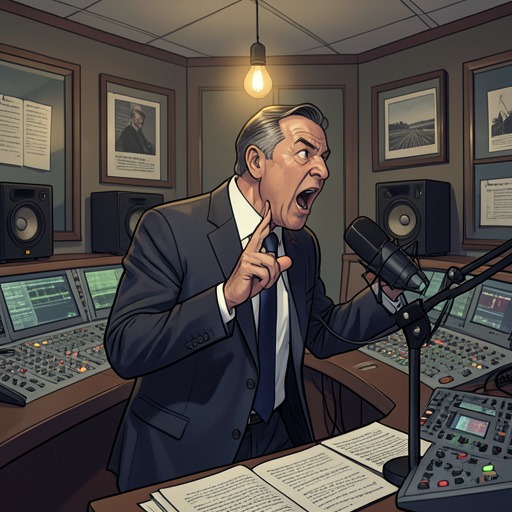
After Lindbergh took office, Roosevelt returned to his estate at Hyde Park and remained out of public view for a time. The Democratic Party’s opposition nevertheless had a prominent public voice in Winchell, who attacked the administration on his Sunday broadcasts. In spring 1942, Roosevelt reappeared to urge Lindbergh to cancel a White House state dinner for Joachim von Ribbentrop. His appeal linked the invitation to the danger facing European peoples under Nazi rule. Vice President Burton K. Wheeler, himself a Democrat serving on Lindbergh’s ticket, attacked Roosevelt for interfering in a sitting president’s foreign policy. Wheeler’s position makes party identity an unstable guide to political allegiance in this alternate government.
Three days after his final newspaper column, Winchell announced that he would seek the Democratic presidential nomination in the next general election. He entered the race almost thirty months before the 1944 election and even before the 1942 midterms, after his firing from broadcasting and the loss of his newspaper column. Several better-established Democrats were already discussed as possible contenders, including Cordell Hull, Henry Wallace, James Farley, William O. Douglas, Paul V. McNutt, and Scott W. Lucas. Eleanor Roosevelt was also mentioned as a possible convention choice if the field deadlocked. Winchell’s early entry altered the contest: he was the Democratic candidate whose name was known nationwide, and he was willing to attack an incumbent whose popularity remained extraordinarily high.
Winchell’s campaign joined presidential ambition to an effort to drive Republicans from Congress in 1942. On September 8 he spoke from a soapbox at Broadway and 42nd Street, drawing nearly ten thousand people as crowds gathered from the streets, buses, and subways. He then addressed neighborhoods across Manhattan and campaigned in other boroughs and New England. The response was uneven: some listeners welcomed him, others ridiculed or shouted him down, and Democratic congressional candidates in Manhattan did not appear near his speeches. His former paper treated the effort as self-promotion, while The New York Times dismissed him as preoccupied with himself. The party thus had a nationally visible campaigner, but the evidence does not show that its congressional candidates embraced his rhetoric or joined his public appearances.
Violence, Succession, and a Party Under Pressure
Winchell’s campaign brought him into direct danger. In Boston, heckling and antisemitic abuse at South Boston’s Perkins Square escalated into a mob attack; armed bodyguards got him away from the crowd and took him for treatment. His campaign exposed the violence that could gather beneath Lindbergh’s popular image, but it also raised difficult questions for the Jewish communities whose safety he claimed to defend. In Newark, Jewish leaders organized the Newark Committee of Concerned Jewish Citizens and sought contingency planning from city and state authorities as fears of further riots grew.
On October 5, 1942, Winchell was assassinated while addressing a political rally in Louisville, Kentucky. His death removed the party’s most conspicuous challenger to Lindbergh and made the killing of a presidential candidate an unprecedented national crisis. Roosevelt, still the party’s central figure, supported New York City mayor Fiorello La Guardia as a national-unity candidate to oppose Lindbergh in 1944. La Guardia’s elevation was an attempt to gather opposition around a new figure, but it followed the loss of a candidate who had forced the administration’s opponents into public view.
The Democratic Party’s significance lies in this movement from governing confidence to contested resistance. Roosevelt’s nomination and defeat establish the scale of Lindbergh’s electoral appeal; Winchell’s campaign shows how opposition could take shape outside the party’s usual leadership and campaigning methods. The party remains a political home for resistance, but its candidates, allies, and public voices do not always act in concert. In a narrative where an incumbent government increasingly treats dissent as conspiracy, the Democrats’ changing fortunes trace both the persistence of electoral opposition and the difficulty of making it effective.